
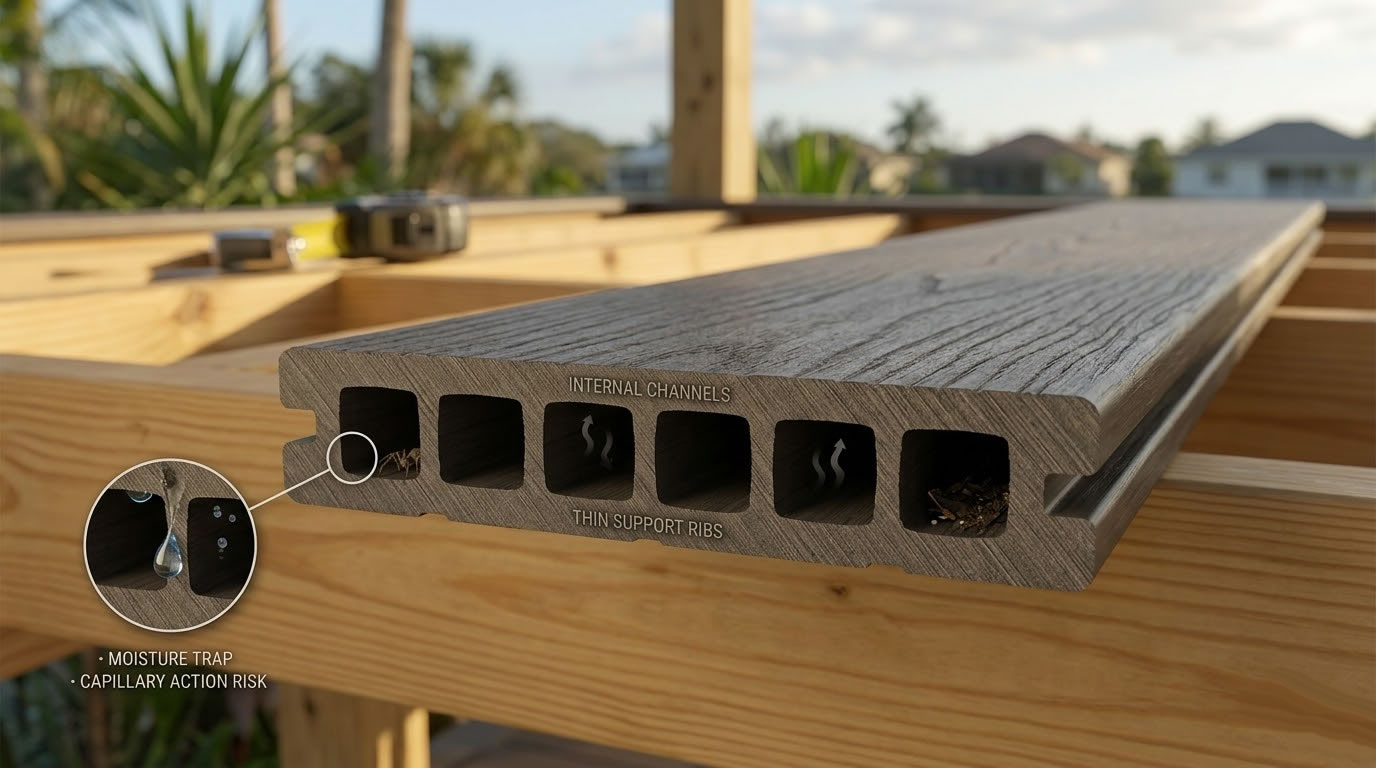
It looks like watertight decking. It’s marketed as watertight decking. But that hollow-core board you’re considering? It might be hiding a problem that won’t show up until years after installation.
When homeowners start researching watertight decking options, they quickly discover that not all boards are built the same. One of the most important differences—and one that’s rarely discussed in showrooms—is the distinction between hollow-core and solid-core construction.
Understanding this difference could save you thousands of dollars and a major headache down the road.
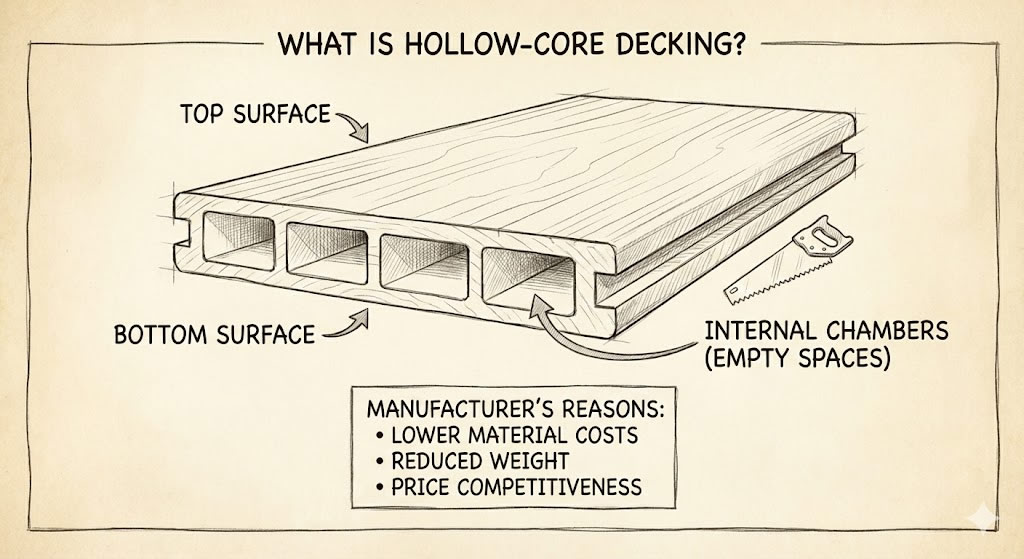
What Is Hollow-Core Decking?
Hollow-core deck boards look solid from the outside. They have a top surface, a bottom surface, and what appears to be a substantial profile. But cut one open, and you’ll find a series of internal chambers—empty spaces supported by thin walls of material.
Manufacturers use this design for a few reasons:
- Lower material costs. Less material per board means lower production costs.
- Reduced weight. Hollow boards are lighter, which can simplify shipping and handling.
- Price competitiveness. The savings can be passed on (or kept as margin), making hollow-core products appear more affordable.
On paper, it seems like a reasonable engineering trade-off. In practice, it creates problems that don’t become obvious until the deck has weathered a few seasons.
The Problems Nobody Talks About
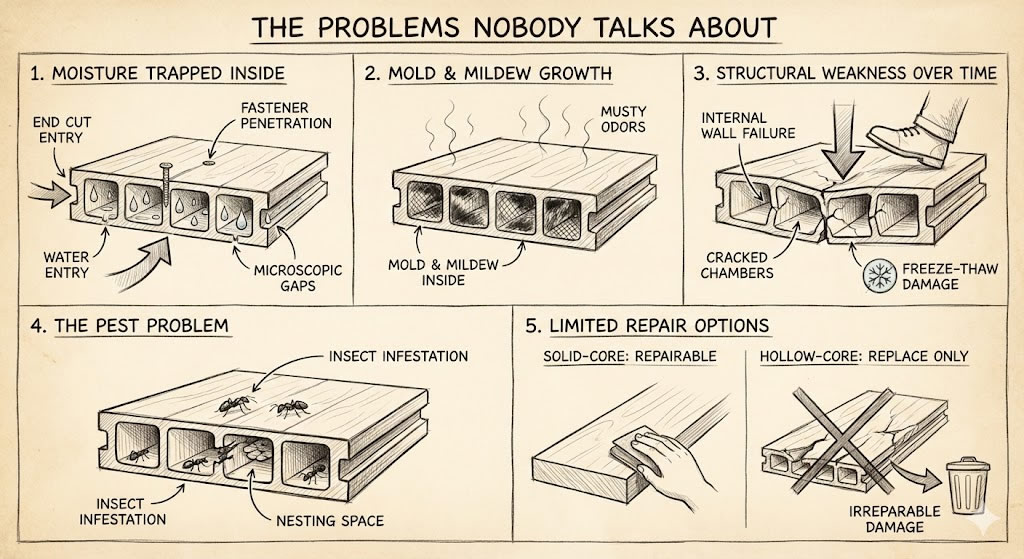
1. Moisture Gets Trapped Inside
Here’s the fundamental issue: hollow chambers create spaces where moisture can accumulate and never fully escape.
Even boards marketed as “watertight” can allow moisture intrusion through:
- End cuts. Every time you cut a hollow-core board to length, you expose the internal chambers. Unless every cut end is perfectly sealed (and stays sealed over time), water has a path inside.
- Fastener penetrations. Screws and fasteners create entry points. While the top surface might shed water, the holes you drill go somewhere—often into those hollow chambers.
- Microscopic gaps. Temperature cycling causes expansion and contraction. Over years, this can create hairline gaps at seams and connections that allow vapor or liquid water to migrate inside.
Once moisture gets into those chambers, it has nowhere to go. The board’s shell that keeps water out also keeps it in. You end up with a deck board that’s wet on the inside while looking dry on the outside.
2. Mold and Mildew Growth
Trapped moisture creates the perfect environment for mold and mildew. Dark, damp, and undisturbed—the inside of a hollow deck board is ideal for fungal growth.
You might not see it for years. The mold grows inside the chambers, invisible from the surface. Eventually, you might notice:
- Musty odors that seem to come from the deck itself
- Discoloration appearing from within the board
- Soft spots where the internal structure has been compromised
By the time these signs appear, the problem is extensive. You’re not dealing with surface mold you can clean—you’re dealing with boards that are rotting from the inside out.
3. Structural Weakness Over Time
Hollow-core boards depend on their internal walls for strength. Those thin supports give the board its rigidity and load-bearing capacity. But those same internal walls are vulnerable.
Moisture damage weakens the internal structure. As trapped water degrades the material, the board loses strength.
Freeze-thaw cycles are particularly destructive. Water that gets inside the chambers expands when it freezes. This can crack internal walls, delaminate layers, and create structural failures that aren’t visible from the surface.
Impact damage affects hollow boards differently than solid ones. A dropped tool or heavy furniture leg can crack internal chambers, compromising strength in ways you can’t see or easily detect.
The result: boards that look fine but have lost significant structural integrity. You might not know there’s a problem until someone steps on a weak spot.
4. The Pest Problem
Hollow chambers can become pathways and nesting spaces for insects. Carpenter ants, in particular, are drawn to moisture-damaged wood and wood composites. The dark, protected channels inside hollow-core boards provide ideal habitat.
Once insects establish themselves inside your deck boards, they’re extremely difficult to eliminate. You can’t reach them with surface treatments. Often, the only solution is board replacement.
5. Limited Repair Options
When a solid-core board gets damaged, you can often address the problem at the surface level. Sand it, fill it, refinish it.
When a hollow-core board fails, your options are limited. The damage is usually internal—invisible, inaccessible, and irreparable. The “repair” is almost always replacement.
This drives up the true lifetime cost of hollow-core decking significantly. What looked like savings at purchase becomes expensive replacements down the road.
Why Do Manufacturers Use Hollow-Core Construction?
It’s worth understanding the business logic, even if it doesn’t serve homeowners well.
Cost reduction is the primary driver. A hollow board uses 30-50% less raw material than a solid board of the same dimensions. For manufacturers producing millions of linear feet, that’s enormous savings.
Shipping economics favor lighter products. Hollow boards cost less to transport, which affects the entire supply chain.
Price sensitivity in the market pushes manufacturers toward designs that hit certain price points. Hollow-core construction allows them to offer “watertight decking” at prices that compete with traditional materials.
None of these reasons have anything to do with performance or longevity. They’re about manufacturing economics and market positioning.
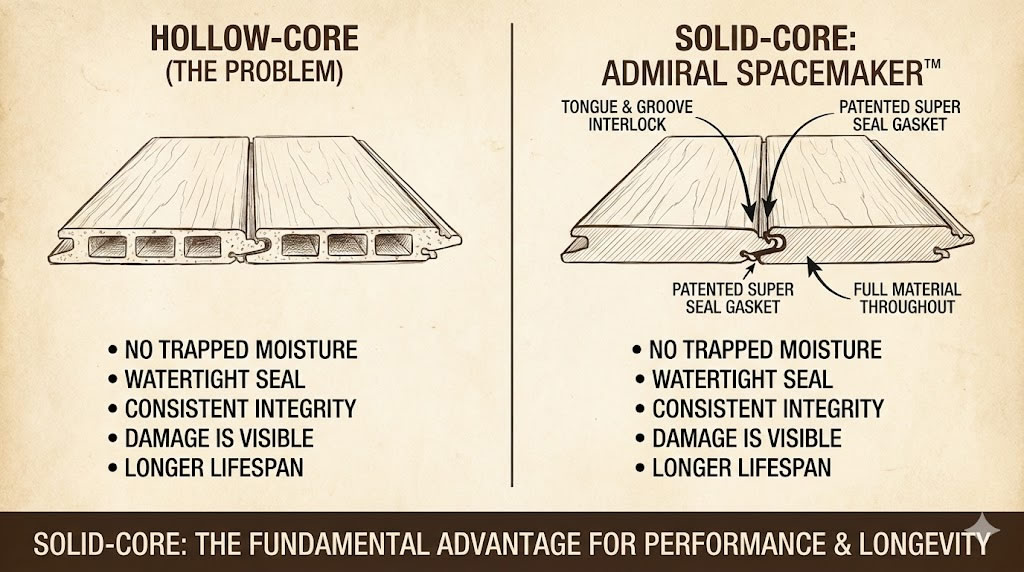
What to Look For: The Solid-Core Difference
Solid-core deck boards take a fundamentally different approach. Instead of hollow chambers, the entire board is material—all the way through.
This construction method costs more to manufacture. It uses more raw material. The boards are heavier. But the performance advantages are significant:
No chambers to trap moisture. Water can’t accumulate inside the board because there’s no inside to accumulate in. The board is the same material throughout.
Consistent strength. Without hollow chambers and thin internal walls, solid-core boards maintain their structural integrity over time. There are no hidden weak points waiting to fail.
True watertight potential. When combined with the right surface treatment and connection system, solid-core boards can deliver genuine watertight performance—not just water resistance that degrades over time.
Damage stays visible. If a solid-core board is damaged, you can see it. There’s no hidden internal deterioration waiting to surprise you years later.
Longer lifespan. Without the internal failure modes that plague hollow-core boards, solid-core construction typically delivers significantly longer service life.
Admiral SpaceMaker: Solid-Core by Design
When we engineered Admiral SpaceMaker decking, solid-core construction wasn’t an afterthought—it was the foundation of the entire system.
We chose solid-core because our goal was never just “watertight-looking decking” at the lowest possible price point. Our goal was a deck system that actually keeps water away from your structure, permanently.
Every SpaceMaker board is solid PVC throughout. No hollow chambers. No internal walls waiting to crack. No hidden spaces where moisture can accumulate and cause invisible damage.
The Super Seal gasket system creates watertight board-to-board connections. The gaskets are integrated into the board design, creating seals that don’t depend on caulk or sealants that degrade over time.
Solid construction supports our structural warranty. We can stand behind our boards because we know what’s inside them—and what’s inside is the same material you see on the surface.
The result is a deck that’s watertight not just today, but for the life of the installation. No hidden moisture accumulation. No internal mold growth. No surprise failures from damage you couldn’t see.
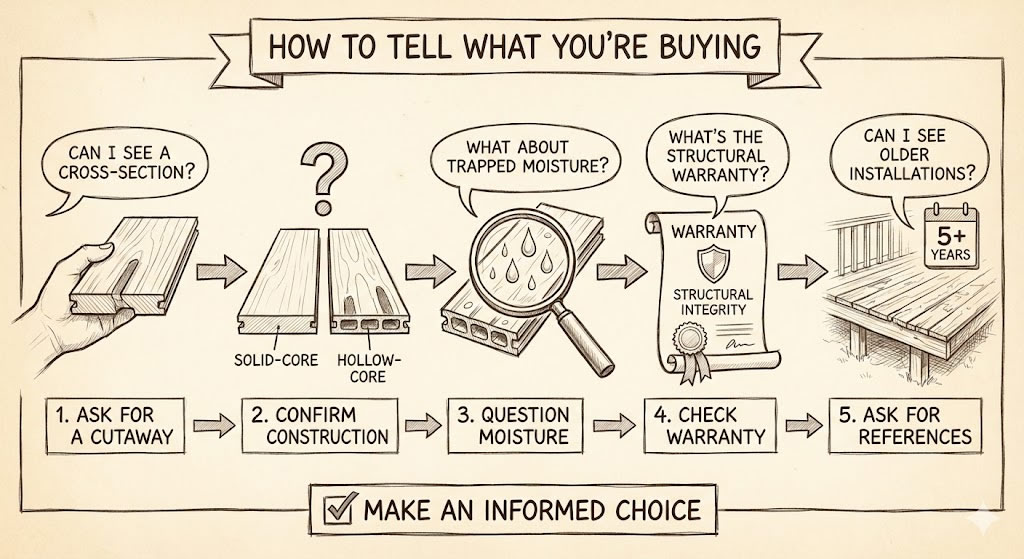
How to Tell What You’re Buying
Before committing to any watertight decking product, ask these questions:
“Can I see a cross-section of the board?” Reputable dealers should be able to show you a cutaway. If they can’t or won’t, that’s a red flag.
“Is this solid-core or hollow-core construction?” Get a direct answer. If the response is vague or evasive, assume hollow-core.
“What happens if moisture gets inside the board?” For solid-core products, this question barely makes sense—there is no “inside.” For hollow-core products, listen carefully to how they address trapped moisture. If they claim it’s not an issue, ask how.
“What’s the warranty on structural integrity?” Companies that use solid-core construction typically offer stronger structural warranties because they have fewer failure modes to worry about.
“Can I see installations that are 5+ years old?” This is where hollow-core problems become visible. Ask for references from older installations and ask those homeowners about their experience.
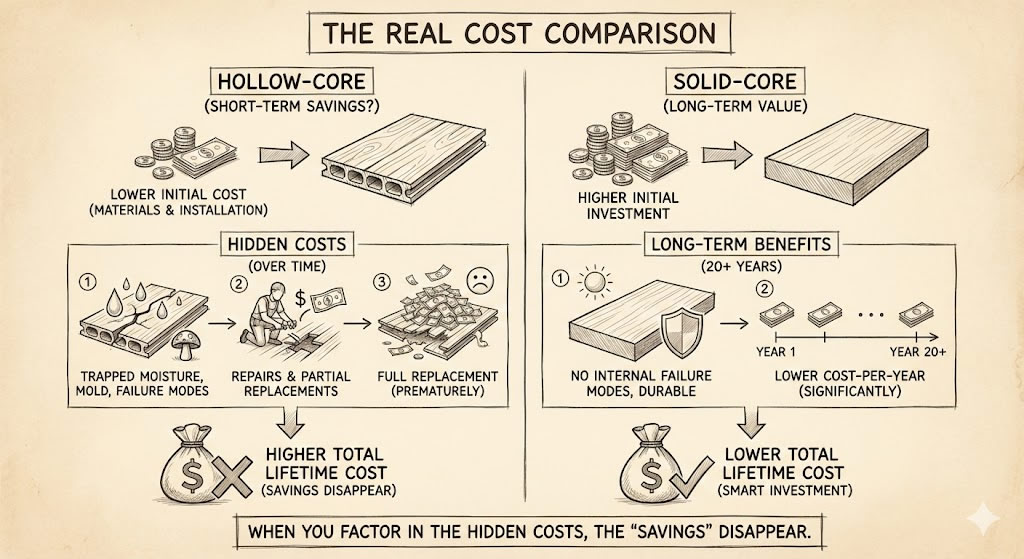
The Real Cost Comparison
Hollow-core decking often looks cheaper at the point of purchase. But the true cost of decking includes:
- Initial materials and installation
- Maintenance over the deck’s lifespan
- Repairs and partial replacements
- Full replacement when boards fail prematurely
When you factor in the hidden costs of hollow-core failure modes—trapped moisture, internal mold, structural degradation, premature replacement—the “savings” often disappear entirely.
Solid-core decking typically costs more upfront. But when that initial investment delivers 20+ years of service without the failure modes that plague hollow-core products, the cost-per-year often favors solid construction significantly.
The Bottom Line
Hollow-core watertight decking isn’t necessarily a scam—it’s a design trade-off that prioritizes manufacturing cost over long-term performance. For some applications, that trade-off might be acceptable.
But if you’re building a deck over living space, creating usable outdoor areas under your deck, or simply want a watertight deck that actually stays watertight for decades, you need to understand what you’re buying.
The hidden problem with hollow-core decking is that the problems are literally hidden—inside the boards, invisible until they’ve caused significant damage.
Admiral SpaceMaker’s solid-core construction eliminates these hidden failure modes entirely. What you see is what you get: solid material throughout, designed to perform for the life of your deck.
When you’re investing in watertight decking, make sure you’re getting watertight performance—not just watertight marketing.
Want to see the difference solid-core construction makes? [Request a SpaceMaker sample] or [contact us for a consultation] to discuss your project.