
You want dry space under your deck. You’ve got two fundamentally different ways to get it. Here’s an honest comparison to help you decide which approach fits your situation.
If you’re building a new deck over a patio, walkout basement, or outdoor living area—or trying to fix a water problem with an existing deck—you’ve probably encountered two categories of solutions: under-deck drainage systems and watertight decking.
Both promise dry space below. Both have their advocates. But they work in completely different ways, and that difference matters more than most homeowners realize.
Let’s break down the real trade-offs so you can make an informed decision.
How Each System Works
Understanding the fundamental approach of each system explains most of their differences.
Under-Deck Drainage Systems
These systems install beneath your deck boards. Your deck surface remains traditional—wood, composite, or whatever material you choose—with gaps between boards as usual.
When it rains, water falls through those gaps, hits the drainage system below, and channels toward the edges of the deck where it exits via gutters or downspouts.
The basic concept: Accept that water will penetrate the deck surface. Catch it underneath. Direct it away.
Watertight Decking
Watertight decking takes the opposite approach. Instead of catching water after it passes through, the deck surface itself is the watertight barrier.
Specialized deck boards with integrated sealing systems prevent water from ever penetrating. Water stays on top of the deck, runs off the surface, and never reaches the structure below.
The basic concept: Stop water at the surface. Nothing to catch underneath because nothing gets through.
The Comparison: 10 Factors That Matter
1. Watertight Effectiveness
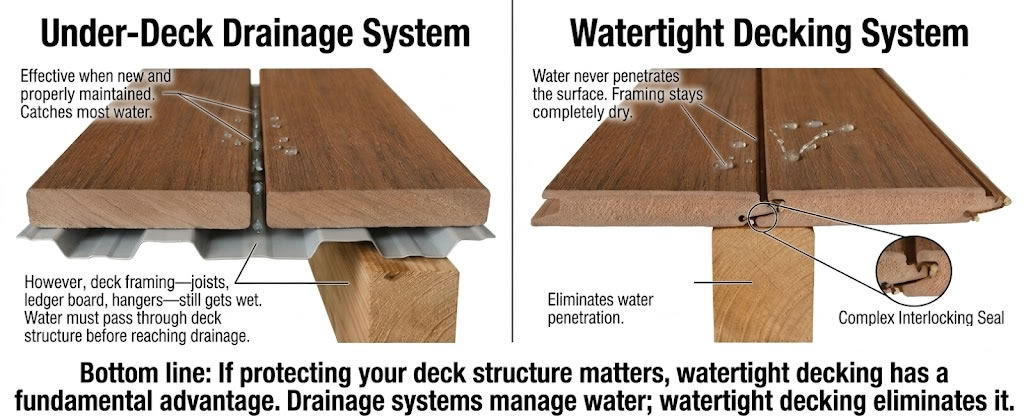
Under-deck drainage: Effective when new and properly maintained. Catches most water that passes through deck gaps. However, the deck framing—joists, ledger board, hangers—still gets wet every time it rains, since water must pass through the deck structure before reaching the drainage system.
Watertight decking: Water never penetrates the surface. Framing stays completely dry. The protection is absolute rather than managed—there’s nothing to catch because nothing gets through.
Bottom line: If protecting your deck structure matters (and it should), watertight decking has a fundamental advantage. Drainage systems manage water; watertight decking eliminates it.
2. Maintenance Requirements
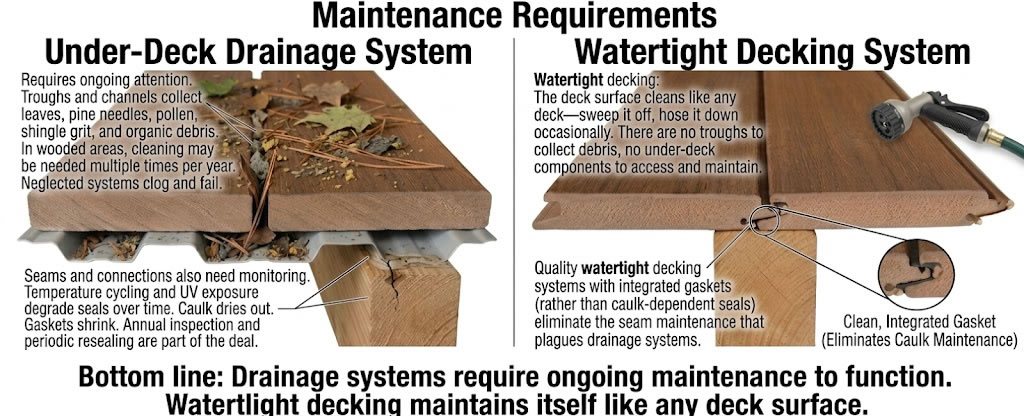
Under-deck drainage: Requires ongoing attention. Troughs and channels collect leaves, pine needles, pollen, shingle grit, and organic debris. In wooded areas, cleaning may be needed multiple times per year. Neglected systems clog and fail.
Seams and connections also need monitoring. Temperature cycling and UV exposure degrade seals over time. Caulk dries out. Gaskets shrink. Annual inspection and periodic resealing are part of the deal.
Watertight decking: The deck surface cleans like any deck—sweep it off, hose it down occasionally. There are no troughs to collect debris, no under-deck components to access and maintain.
Quality watertight decking systems with integrated gaskets (rather than caulk-dependent seals) eliminate the seam maintenance that plagues drainage systems.
Bottom line: Drainage systems require ongoing maintenance to function. Watertight decking maintains itself like any deck surface.
3. Longevity and Failure Modes
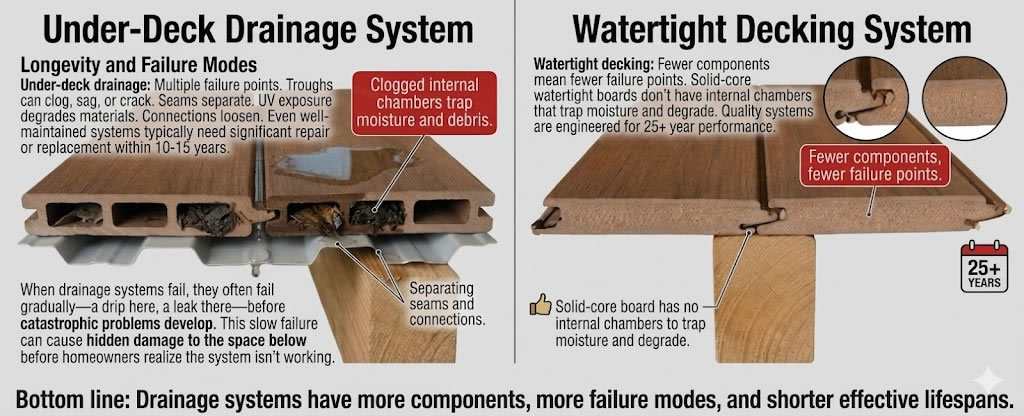
Under-deck drainage: Multiple failure points. Troughs can clog, sag, or crack. Seams separate. UV exposure degrades materials. Connections loosen. Even well-maintained systems typically need significant repair or replacement within 10-15 years.
When drainage systems fail, they often fail gradually—a drip here, a leak there—before catastrophic problems develop. This slow failure can cause hidden damage to the space below before homeowners realize the system isn’t working.
Watertight decking: Fewer components mean fewer failure points. Solid-core watertight boards don’t have internal chambers that trap moisture and degrade. Quality systems are engineered for 25+ year performance.
Failures, when they occur, are typically visible—a damaged board, a displaced gasket—rather than hidden.
Bottom line: Drainage systems have more components, more failure modes, and shorter effective lifespans.
4. Impact on Deck Structure
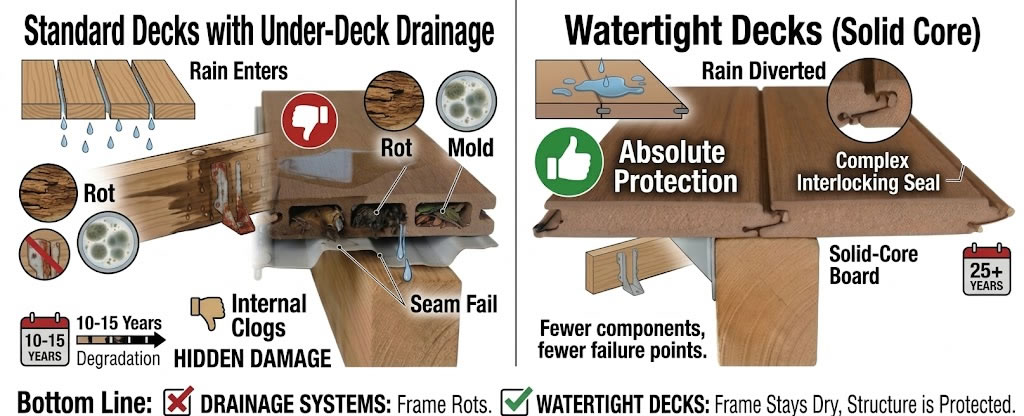
Under-deck drainage: Your joists, ledger board, and metal hangers get wet every single time it rains. The drainage system catches water after it passes through the deck structure.
Over years, this repeated wetting causes:
- Rot in wooden framing (even pressure-treated lumber eventually fails)
- Corrosion of metal joist hangers and fasteners
- Mold growth in framing members
- Gradual structural weakening
Watertight decking: Water never contacts the framing. Joists stay dry. Hangers don’t corrode. The structure underneath is protected for the life of the deck.
Bottom line: This is perhaps the most overlooked difference. Drainage systems protect the space below but not the structure itself. Watertight decking protects both.
5. Appearance from Below
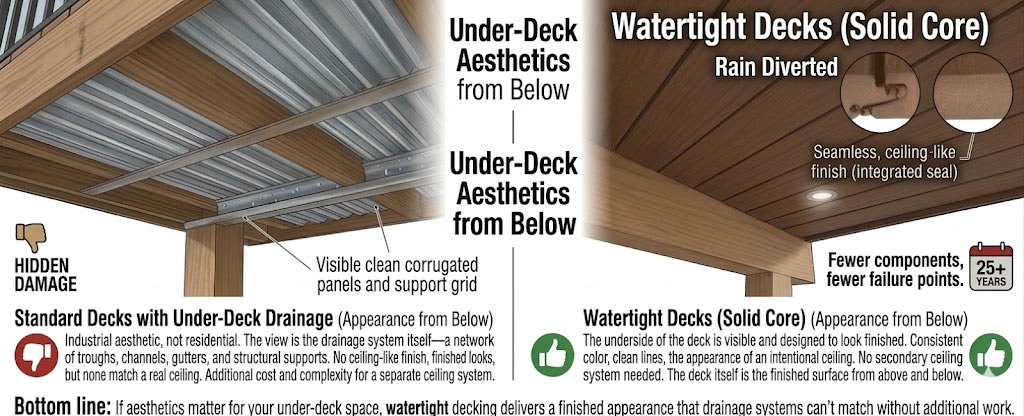
Under-deck drainage: The view from below is the drainage system itself—typically a network of troughs, channels, gutters, and structural supports. Industrial rather than residential in appearance.
Some systems offer more finished looks than others, but none match the appearance of an actual ceiling. Homeowners who want finished aesthetics below often install a separate ceiling system under the drainage components—adding cost and complexity.
Watertight decking: The underside of the deck boards is visible—and with quality systems, that underside is designed to look finished. Consistent color, clean lines, the appearance of an intentional ceiling rather than mechanical infrastructure.
No secondary ceiling system needed. The deck itself is the finished surface from both above and below.
Bottom line: If aesthetics matter for your under-deck space, watertight decking delivers a finished appearance that drainage systems can’t match without additional work.
6. Installation Complexity
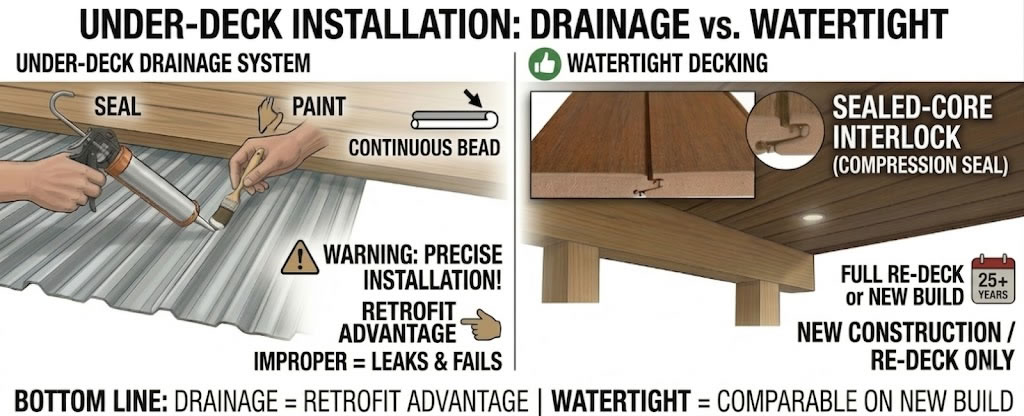
Under-deck drainage: Can be installed under existing decks without removing the deck boards (a significant advantage for retrofit situations). However, proper installation requires careful attention to pitch, seam sealing, and gutter connections. Improper installation leads to pooling, leaks, and early failure.
Professional installation is strongly recommended. DIY installation is possible but mistakes are common and costly.
Watertight decking: Requires the deck boards themselves to be watertight—so this is typically a new deck installation or a full re-decking project. More disruptive if you’re keeping an existing deck structure.
Installation of quality watertight decking is similar to traditional decking, with attention to the gasket or sealing system between boards.
Bottom line: For retrofitting under an existing deck you want to keep, drainage systems have an installation advantage. For new construction or re-decking, watertight decking is comparable in installation complexity.
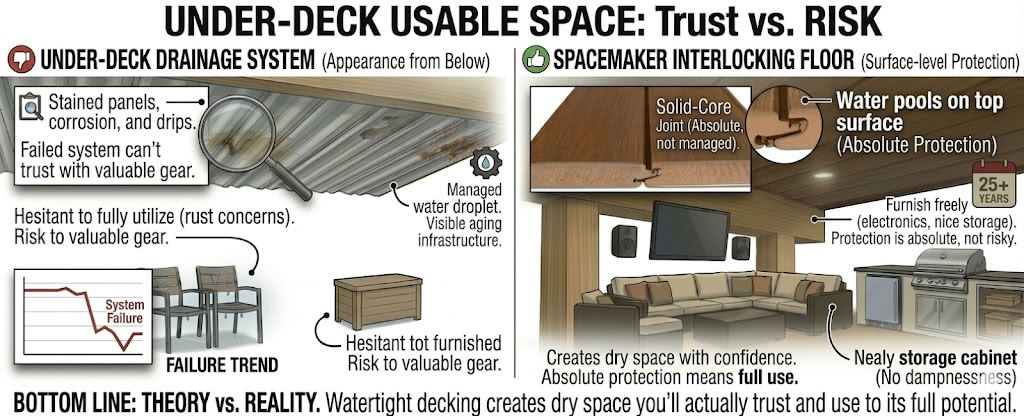
7. Usable Space Quality
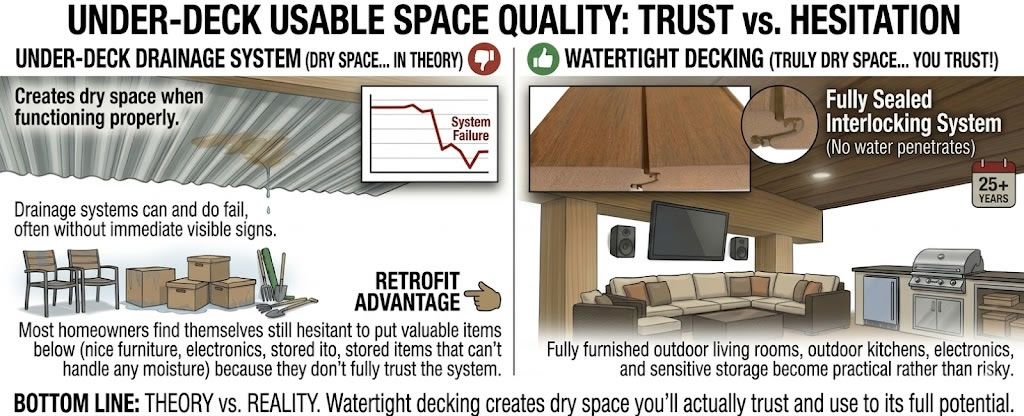
Under-deck drainage: Creates dry space when functioning properly. However, most homeowners find themselves still hesitant to put valuable items below—nice furniture, electronics, stored items that can’t handle any moisture—because they don’t fully trust the system.
That hesitation is reasonable. Drainage systems can and do fail, often without immediate visible signs.
Watertight decking: Creates truly dry space with a higher confidence level. Because the protection is absolute (no water ever penetrates) rather than managed (water is caught after penetrating), homeowners use the space more freely.
Fully furnished outdoor living rooms, outdoor kitchens, electronics, and sensitive storage become practical rather than risky.
Bottom line: Both create dry space in theory. Watertight decking creates dry space you’ll actually trust and use to its full potential.
8. Compatibility with Deck Features
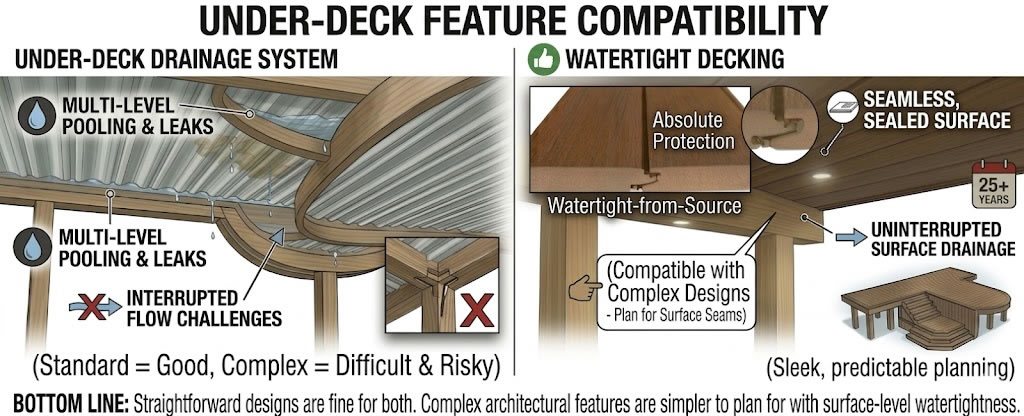
Under-deck drainage: Works with most standard deck boards and designs. However, some complex deck features—multiple levels, curved sections, unusual angles—create drainage challenges. Water needs to flow; anything that interrupts that flow creates potential pooling and leakage points.
Watertight decking: Works with standard deck designs. Complex architectural features may require more planning but don’t create the drainage issues that complicate trough systems.
Bottom line: Both work for straightforward deck designs. Complex features may be easier to watertight with surface-level systems than with under-deck drainage.
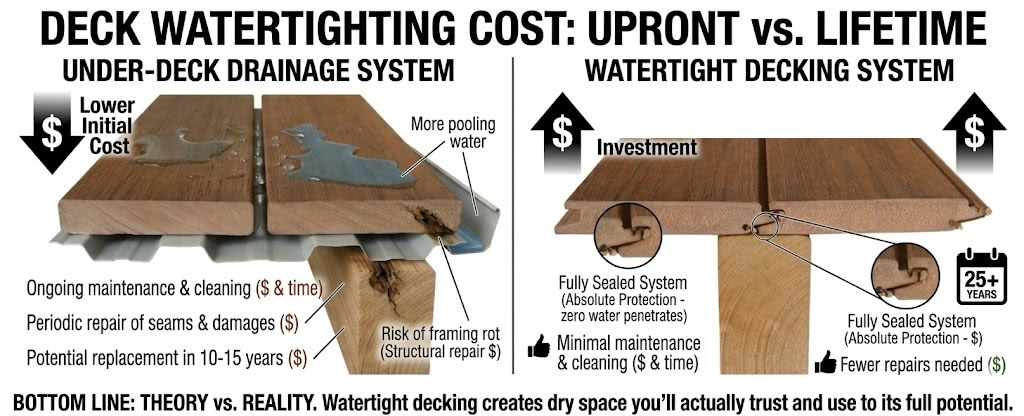
9. Cost Comparison
Under-deck drainage: Lower initial cost in most cases. Materials are less expensive than watertight decking. Can be retrofitted without replacing deck boards (saving on materials and labor).
However, long-term costs include:
- Ongoing maintenance time or professional cleaning
- Periodic repair of seams, connections, and damaged sections
- Potential full replacement within 10-15 years
- Possible structural repairs from moisture damage to framing
Watertight decking: Higher initial investment. Watertight deck boards cost more than traditional materials. New decking or re-decking is required (can’t retrofit under existing boards).
Long-term costs are typically lower:
- Minimal maintenance requirements
- Fewer repairs needed
- Longer system lifespan (25+ years)
- No structural damage from moisture
Bottom line: Drainage systems cost less upfront but often cost more over the life of the deck. Watertight decking costs more initially but typically delivers lower total cost of ownership.
10. Resale Value and Buyer Perception
Under-deck drainage: Buyers recognize the value of dry space underneath a deck. However, informed buyers also recognize the maintenance burden and potential failure modes. A visibly aging drainage system can raise concerns during home inspections.
Watertight decking: Presents as a premium feature—a deck system that delivers both a quality deck surface and a protected space below. No visible drainage infrastructure to raise maintenance questions. The finished ceiling appearance from below signals quality construction.
Bottom line: Both add value compared to an unprotected under-deck area. Watertight decking typically presents as a more premium, lower-maintenance feature.
Decision Framework: Which Is Right for You?
Under-deck drainage may be the better choice if:
- You have an existing deck in good condition and don’t want to replace the deck boards
- Your budget is limited and you need the lowest upfront cost
- You’re comfortable with ongoing maintenance
- The space below is for casual use rather than finished outdoor living
- Short-term performance (5-10 years) matters more than lifetime value
Watertight decking is likely the better choice if:
- You’re building a new deck or already planning to re-deck
- You want to protect your deck framing, not just the space below
- Low maintenance is a priority
- You’re creating finished outdoor living space underneath
- Long-term value and performance matter more than initial cost
- You want a finished ceiling appearance from below without adding separate systems
Our Recommendation: Admiral SpaceMaker
At Admiral SpaceMaker, we obviously believe watertight decking is the better long-term solution—that’s why we built our business around it.
But we didn’t design SpaceMaker just to be “watertight decking.” We designed it to address the specific weaknesses we saw in the category:
Solid-core construction eliminates the hidden moisture problems that plague hollow-core watertight boards. No internal chambers where water accumulates and causes invisible damage.
The Super Seal gasket system creates watertight board-to-board connections without relying on caulk or sealants that degrade over time. The watertightness is built into the board design, not added after the fact.
Finished appearance from below means you get a ceiling-like look underneath—not drainage infrastructure, not raw board undersides, but an intentional finished surface.
Protection for your framing because water never penetrates. Your joists, ledger, and hardware stay dry for the life of the deck.
If you’re weighing the options, we’re happy to discuss your specific situation. Sometimes drainage systems make sense. Often, watertight decking is the smarter long-term investment. We’ll give you an honest assessment either way.
The Bottom Line
Under-deck drainage and watertight decking both solve the same problem—keeping the space under your deck dry—but they do it in fundamentally different ways with different trade-offs.
Drainage systems manage water after it penetrates your deck. They’re less expensive upfront, can retrofit under existing decks, and work well when maintained. But they require ongoing attention, have multiple failure points, and don’t protect your deck structure from moisture.
Watertight decking stops water at the surface. It costs more initially and requires new or replacement decking, but delivers lower lifetime costs, minimal maintenance, structural protection, and a finished appearance from below.
Neither is universally “better.” The right choice depends on your situation, priorities, and budget.
But if you’re investing in a space you plan to use and enjoy for decades, watertight decking typically delivers more value over time—and more peace of mind from day one.
Have questions about which approach is right for your project? [Contact us for a consultation]—we’ll give you an honest assessment based on your specific situation.
Related Articles:
- Why Most Under-Deck Drainage Systems Fail (And What Actually Works)
- The Hidden Problem with Hollow-Core Watertight Decking
- How to Create Usable Space Under Your Second-Story Deck