
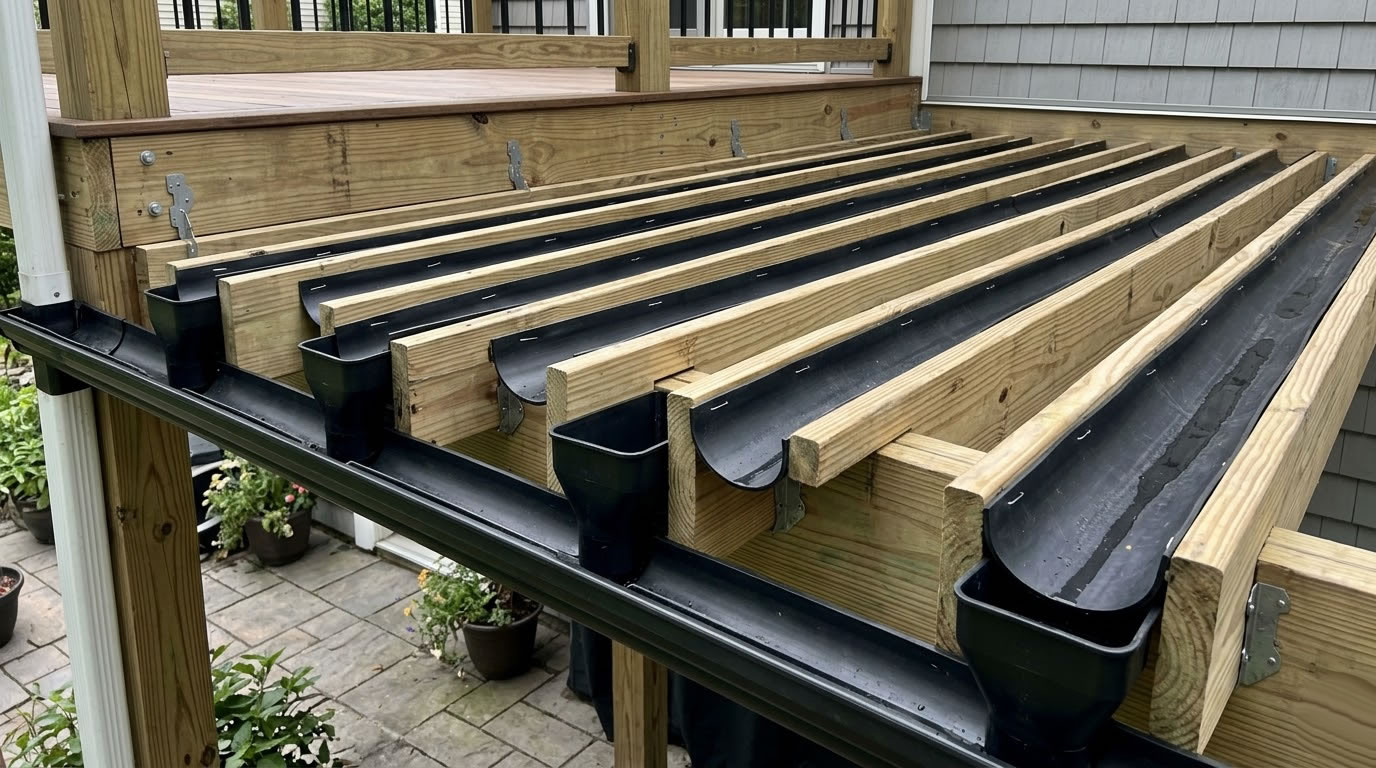
You invested thousands in an under-deck drainage system. Now you’re watching water drip through anyway, staining your patio furniture and pooling where your outdoor kitchen was supposed to go. Sound familiar?
You’re not alone. Every year, thousands of homeowners discover that their “watertight” under-deck solution isn’t actually keeping things dry. The good news: once you understand why these systems fail, you can make a smarter choice—one that actually works.
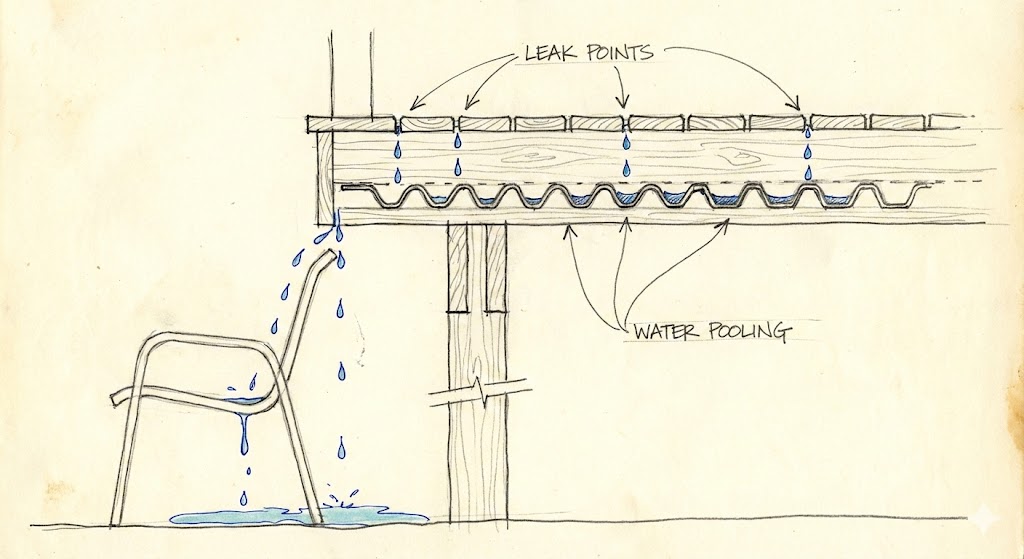
The Promise vs. The Reality
Under-deck drainage systems sound great on paper. Install a network of troughs or panels beneath your deck boards, and water flows away instead of dripping through. Simple, right?
Here’s what the brochures don’t tell you: these systems are fighting physics from day one. They’re designed to manage water after it’s already penetrated your deck—not to keep it out in the first place. That fundamental flaw leads to a cascade of problems that show up months or years after installation.
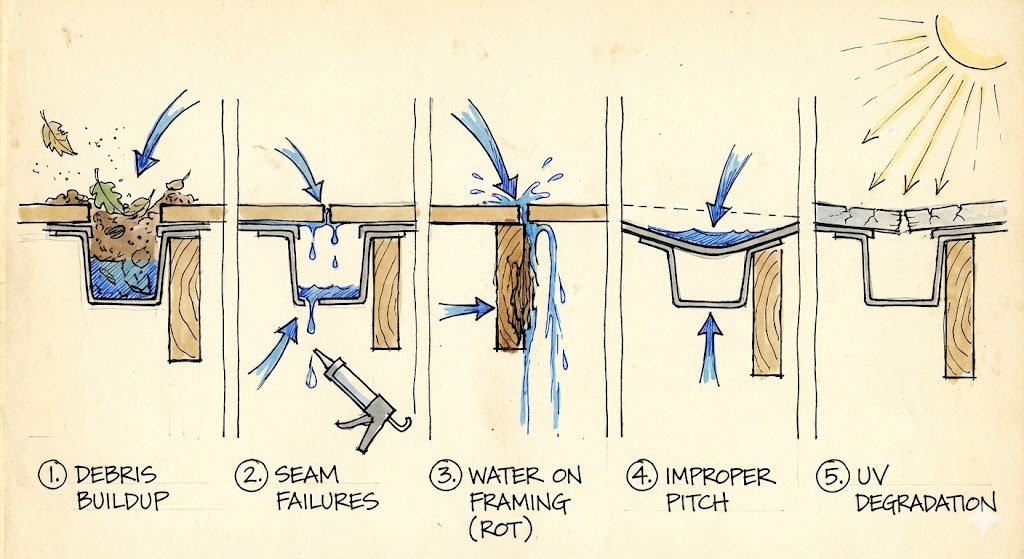
The 5 Most Common Failure Points
1. Debris Buildup in Troughs
Trough-style drainage systems rely on channels that catch water and direct it to the edges of your deck. The problem? Those same channels catch everything else too.
Leaves, pine needles, pollen, shingle grit, and organic debris accumulate in the troughs over time. In wooded areas, this happens faster than most homeowners expect. Within a season or two, the troughs become clogged. Water backs up, overflows the channels, and drips through anyway.
What you’ll notice: Random dripping that gets worse over time, especially after storms. Water stains appearing in new locations. A musty smell from decomposing debris trapped above your patio.
The fix most people try: Climbing up there to clean it out. Which works—until you realize you’ll be doing this maintenance forever.
2. Seam and Connection Failures
Every under-deck drainage system has seams. Panels connect to panels. Troughs meet at corners. Gutters attach to downspouts. Each connection point is a potential failure point.
Temperature swings cause materials to expand and contract. UV exposure degrades seals. Settling of the deck structure shifts alignment. Over time, tight seams become gaps. Secure connections become loose.
What you’ll notice: Dripping specifically at seam locations. Water marks that follow straight lines (where panels meet). Leaks that appear suddenly after a cold snap or heat wave.
The fix most people try: Caulk. Lots of caulk. Which buys you maybe another season before the same forces that opened the first gap open another.
3. Water Still Hits Your Framing
This is the problem most homeowners don’t think about until it’s too late. Even when trough systems work perfectly, water still lands on your deck and flows through the gaps between boards before the drainage system catches it.
That means your joists, ledger board, and structural framing are still getting wet. Every single time it rains.
Over years, this leads to:
- Rot in wooden joists (even pressure-treated lumber eventually fails)
- Corrosion of metal hangers and fasteners
- Mold growth in the framing
- Structural concerns that are invisible until they’re serious
What you’ll notice: Nothing—at first. This is the silent failure. By the time you see soft spots, discoloration, or structural sagging, the damage is extensive.
The fix most people try: There isn’t one. If your system lets water reach your framing, you’re accepting gradual structural degradation as the cost of doing business.
4. Improper Pitch and Installation Errors
Drainage systems depend on gravity. Water needs to flow toward the exit points, which means the entire system must be pitched correctly—typically a minimum of 1/8″ per foot. Get this wrong, and water pools instead of draining.
The challenge: maintaining perfect pitch across a system that spans your entire deck footprint, while working around joists, blocking, and other structural elements. Many installers get it close but not perfect. Some areas drain well; others become standing water zones.
What you’ll notice: Puddles that take days to dry. Sagging panels. Water that drains in some areas but not others. That distinctive algae-green tint where water sits too long.
The fix most people try: Adding more pitch after the fact, which usually means reinstalling large sections of the system. Or living with it and hoping the standing water doesn’t cause bigger problems (it will).
5. UV Degradation and Material Breakdown
Most under-deck drainage materials are plastic or vinyl-based. While they’re marketed as durable, they’re constantly exposed to reflected UV rays bouncing off your deck surface and direct sun exposure in certain configurations.
Over 5-10 years, these materials become brittle. Colors fade. Flexibility disappears. Panels that once sealed tightly develop hairline cracks. Components that used to snap together firmly become loose.
What you’ll notice: Fading and discoloration first. Then brittleness—panels that crack when you touch them. Eventually, widespread small failures as the material simply gives out.
The fix most people try: Replacement. Which means paying for the same system again, knowing it’ll fail the same way in another decade.
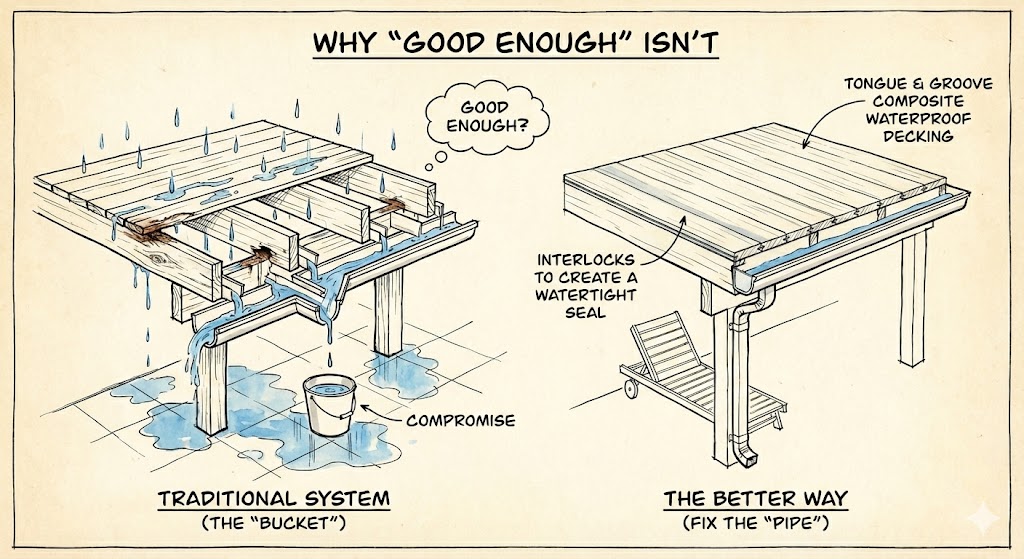
Why “Good Enough” Isn’t Good Enough
Here’s the uncomfortable truth about under-deck drainage systems: even when they work, they’re a compromise.
Think about what you actually want:
- Dry, usable space under your deck
- No water damage to your deck structure
- Low maintenance
- Long-term reliability
Traditional drainage systems can deliver the first point—sometimes, for a while, with regular maintenance. But they fundamentally can’t deliver the rest because they’re designed to manage water after it enters your deck system rather than keeping it out entirely.
It’s like putting a bucket under a leaky pipe instead of fixing the pipe.
What Actually Works: Admiral SpaceMaker
At Admiral SpaceMaker, we took a different approach. Instead of trying to catch water after it penetrates your deck, we asked a simple question: what if water never got through in the first place?
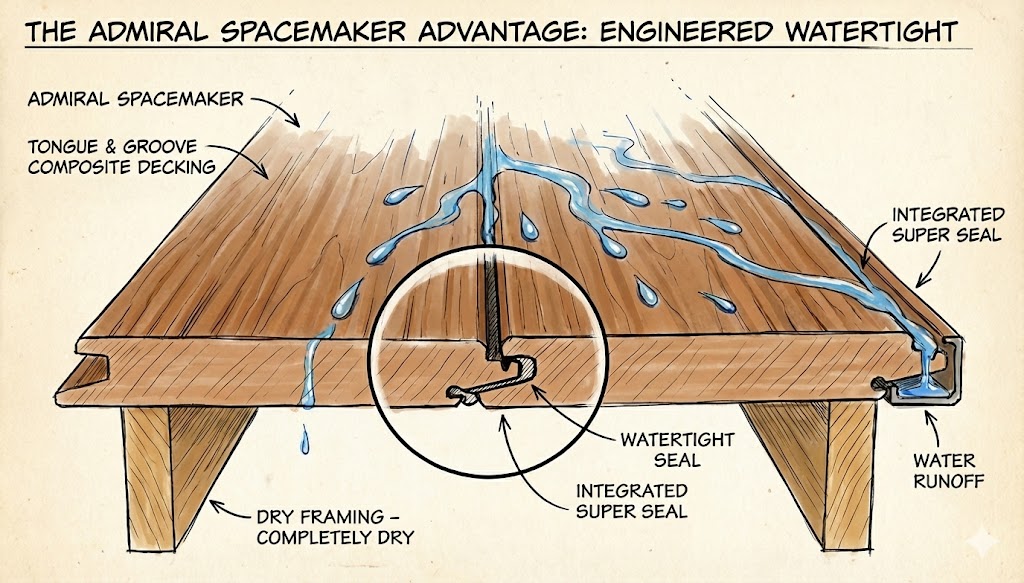
That’s the principle behind our solid-core watertight decking system. The deck board itself becomes the watertight barrier. Water never penetrates. Your framing stays dry. The space below stays dry. No troughs to clog. No seams to fail. No water touching your structure—ever.
How Admiral SpaceMaker Solves Each Failure Point
Problem: Debris clogs drainage troughs. SpaceMaker solution: There are no troughs. Water stays on top of the deck surface and runs off the edges. Nothing to clog. Nothing to clean.
Problem: Seams and connections fail over time. SpaceMaker solution: Our patented Super Seal gasket system creates watertight connections between every board. The gaskets are built into the boards themselves—no caulk, no separate sealants, no components that degrade independently.
Problem: Water still reaches your framing. SpaceMaker solution: Water never passes through the deck surface. Your joists, ledger board, and fasteners stay completely dry, every time it rains, for the life of the deck.
Problem: Improper pitch causes pooling. SpaceMaker solution: Because water stays on top of the deck (not underneath it), standard deck pitch handles drainage naturally. No separate system to align. No troughs to level.
Problem: Materials degrade from UV exposure. SpaceMaker solution: Our solid-core construction is engineered for long-term UV stability. Unlike hollow-core alternatives that can trap moisture internally, solid-core boards maintain their integrity year after year.
The All-in-One Advantage
Traditional approaches require multiple systems: your deck boards, plus a drainage system underneath, plus a separate ceiling system if you want a finished look below. That’s three systems to buy, install, and maintain—each with its own failure points.
Admiral SpaceMaker is a true all-in-one solution. Your deck surface is your watertight barrier is your finished ceiling. One system. One installation. One solution that actually works.
Making the Right Choice for Your Situation
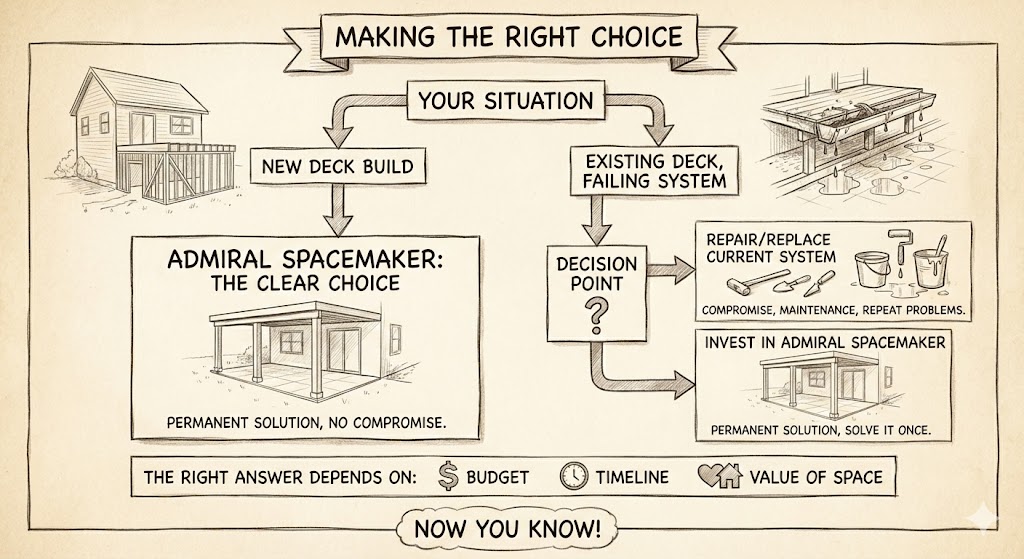
If you’re building a new deck over living space, the choice is clear: start with Admiral SpaceMaker and avoid the drainage-system compromises entirely.
If you have an existing deck with a failing drainage system, you have a decision to make. You can repair or replace the current system—knowing you’ll likely face the same problems again. Or you can invest in Admiral SpaceMaker and solve the problem permanently.
The right answer depends on your budget, your timeline, and how much you value that under-deck space. But now you know the questions to ask and the pitfalls to avoid.
The Bottom Line
Under-deck drainage systems fail because they’re designed around a flawed premise: that you can reliably catch and channel water in a system exposed to debris, temperature extremes, UV radiation, and the constant forces of expansion and contraction.
For decades, these systems were the only option. Homeowners accepted the maintenance burden and the eventual failures because there was no alternative.
Admiral SpaceMaker changed that. Our solid-core, 100% watertight deck boards with integrated Super Seal gasket technology keep water from ever reaching your framing. No troughs to clean. No seams to fail. Just dry space below your deck, year after year.
If you’re tired of managing water and ready to eliminate it, we’re here to help.
Ready to see how Admiral SpaceMaker could work for your project? [Request a consultation] or [browse our project gallery] to see real installations in homes like yours.