
If you’re comparing composite or PVC decking options right now, you’ve probably spent a lot of time on color, grain pattern, and warranty length. That’s the natural place to start – it’s what you’ll see and touch every day. But the research that actually protects your investment happens one layer down, in a place most homeowners don’t think to look until something goes wrong: the frame underneath the boards.
What Causes Deck Joist Rot in the First Place
Standard deck boards, whether wood, composite, or PVC, are installed with a gap of roughly 1/8” to 1/4” between each board. Those gaps are intentional – they let rainwater drain through quickly and give the boards room to expand and contract with temperature swings. As a strategy for protecting the boards themselves, it works fine.
The problem is everything below the gaps.
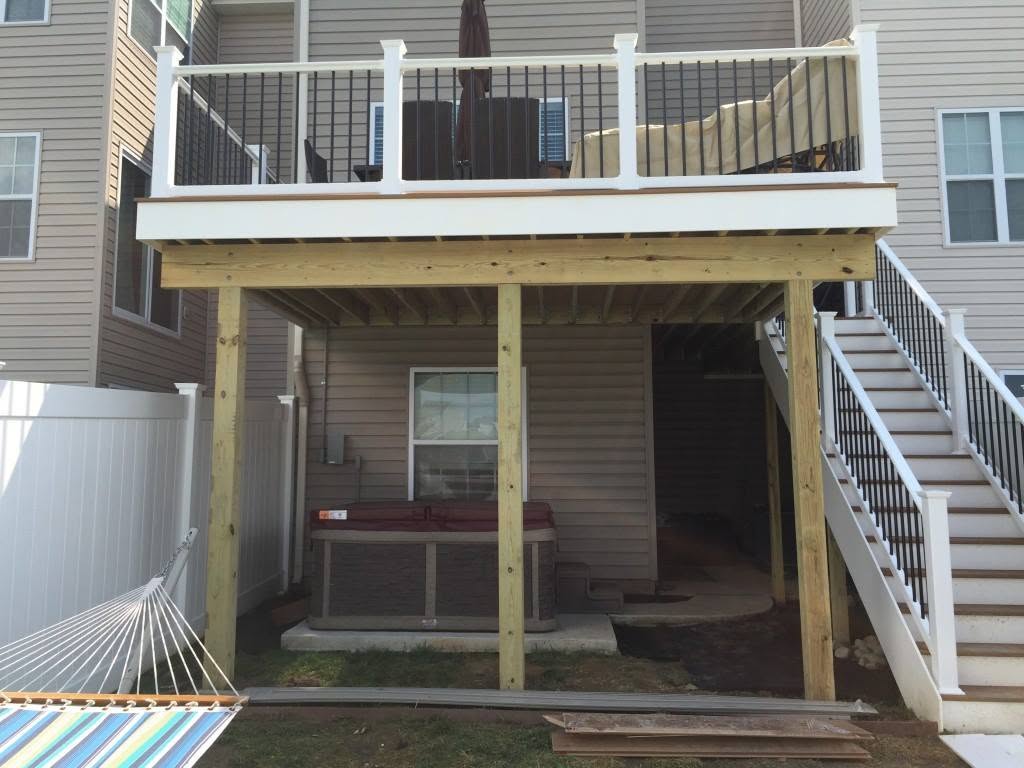
Rain, snowmelt, and condensation pass straight through those narrow channels and land directly on the pressure-treated joists, beams, ledger board, and fasteners that make up the deck’s frame. Leaves, pollen, and dirt follow the same path and settle into the joints, joist hangers, and screw heads – holding moisture against the wood long after a storm has passed and the surface above looks completely dry. This is the mechanism behind deck framing rot, and it’s happening on the vast majority of decks built with standard gapped boards, regardless of how premium the surface material is.
How Long Does Deck Framing Actually Last?
This is usually the question that brings homeowners here, and it deserves a real answer.
Wood decay is a fungal process with specific, well-documented requirements. Decay fungi generally need oxygen, a food source (the wood itself), moderate temperatures between roughly 40°F and 100°F, and moisture content above roughly 19–28%, depending on the species. Pressure-treated lumber typically arrives at 15–19% moisture content and is safe as long as it can dry out between wet events. A joist under a gapped deck rarely gets that chance – repeated wetting, combined with trapped debris blocking airflow, keeps the wood cycling at or above the decay threshold for weeks at a time, especially in shaded or low-clearance crawl spaces.
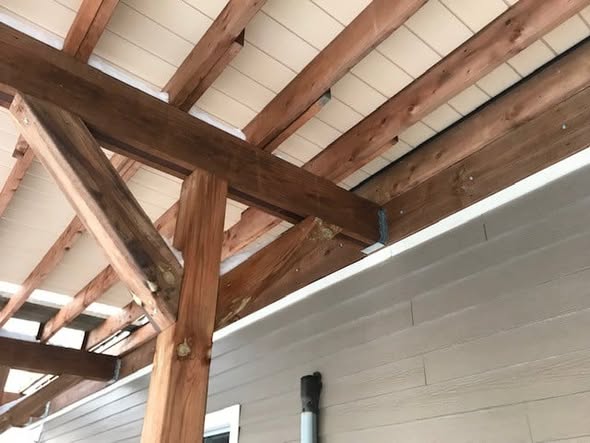
That cycling is also what drives most fastener failure. Modern pressure-treated lumber uses copper-based preservatives (ACQ or MCA) that are more corrosive to fasteners than older treatments. Fasteners that stay damp lose holding strength well before the surrounding wood visibly fails, which is why loose railings and popped screws are often the first sign of a much larger problem happening out of sight.
Put together, pressure-treated framing under a gapped deck commonly needs structural attention within 10 to 20 years – often well before a 25- to 50-year composite decking warranty on the surface above it has run its course.
What Pressure Treated Deck Rot Actually Costs
The numbers are worth knowing before you finalize a material decision:
- A full substructure rebuild (joists, beams, ledger, hardware) typically runs $15–$35 per square foot in labor and material, on top of what was already spent on the surface, since the boards usually have to come up to access the frame.
- For a typical 300–400 sq. ft. deck, that puts a mid-life reframe in the $4,500–$14,000 range.
- That’s money spent redoing structural work that, in many cases, never showed a visible sign of failure from above until it was significant.
In other words, it’s possible to pay for a premium deck surface twice: once for the original build, and again to rebuild the frame that the surface was never designed to protect.
Preventing Deck Water Damage at the Source
This is the problem Admiral SpaceMaker decking was engineered to solve, and it’s worth understanding the mechanism rather than taking it on faith.
Instead of gapped boards with open channels straight to the frame, SpaceMaker uses an interlocking tongue-and-groove composite profile. Each board’s edge overlaps the next, so the surface functions as a continuous, sloped drainage plane rather than individual slats. Water lands on top, runs across the surface following the deck’s built-in pitch, and exits at a perimeter drainage edge – never reaching the joists below.
The framing stays dry not because it’s been treated to resist water better, but because the water is never given a path to reach it. That removes the wet-dry cycling that drives both fungal decay and fastener corrosion, which is the actual root cause of deck framing rot. A frame that stays consistently dry isn’t subject to the same 10–20 year decline that ends most gapped decks well before their surface wears out.
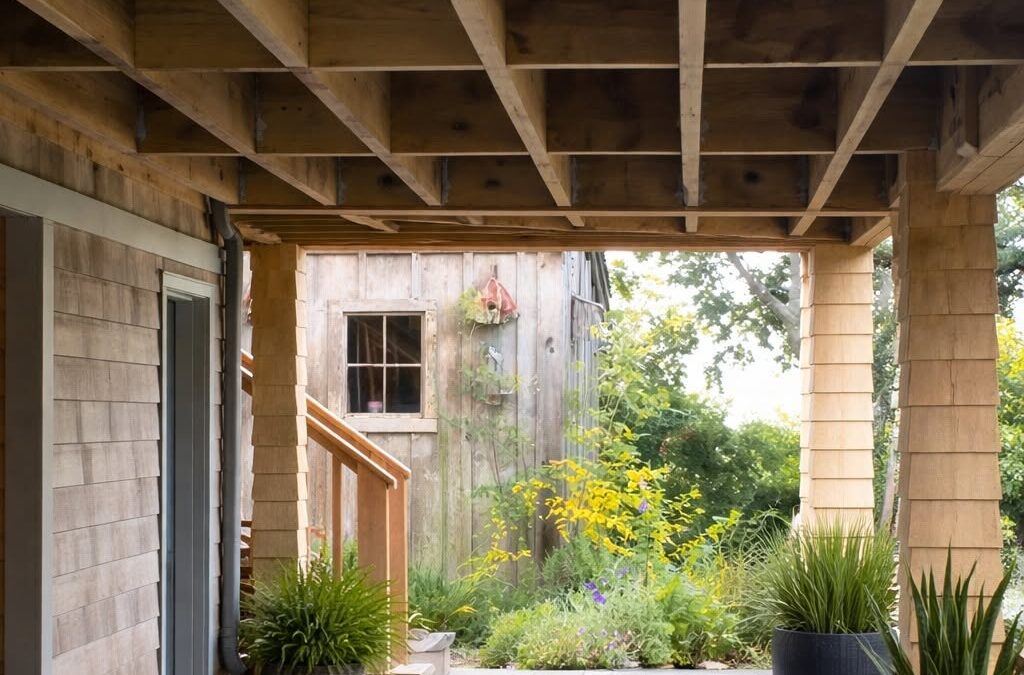
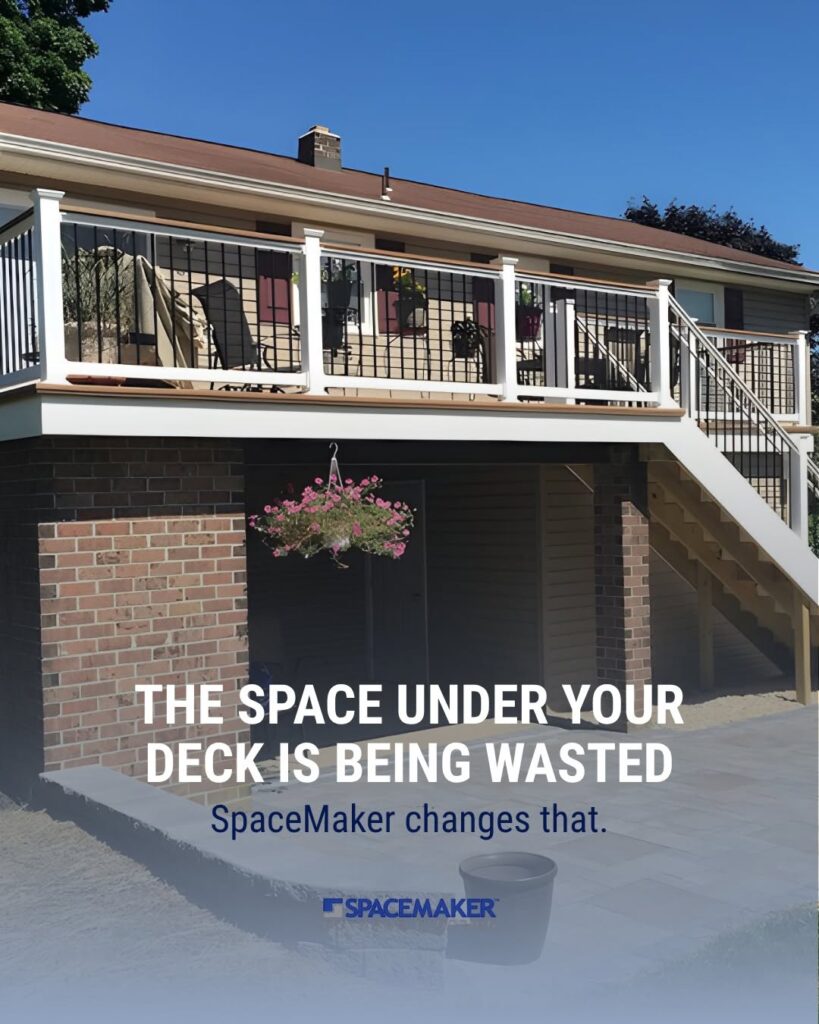
There’s a practical bonus, too: the underside of a SpaceMaker deck becomes a finished, weather-protected ceiling, so the space below an elevated deck turns into something usable – a dry patio, a covered sitting area, or protected storage. But the reason to take this seriously as a substructure decision, not just a surface upgrade, is what it does for the part of the deck you can’t see.
Gapped Decking vs. SpaceMaker, Side by Side
| Traditional gapped decking | Admiral SpaceMaker | |
| Water reaches joists/hardware | Yes, every rain event | No – routed to perimeter edge |
| Typical framing service life before major repair | ~10–20 years | Extended significantly by removing wet-dry cycling |
| Space underneath usable in rain | No | Yes – stays dry |
| Fastener corrosion risk | Elevated, especially with ACQ-treated lumber | Reduced – hardware stays dry |
Making the Call for Your Own Deck
At this point you’ve likely got the two pieces of information that actually matter for a long-term decking decision: what causes deck framing to fail, and what it costs when it does. The surface material determines how your deck looks for the next few decades. The drainage system underneath it determines whether you get to keep that surface without a mid-life structural rebuild.
Photos and spec sheets only tell you so much about how a tongue-and-groove drainage system actually performs – most homeowners find it clicks once they can see the overlap and feel how the boards interlock in person.
See and feel the difference for yourself. Request a free SpaceMaker sample and check the drainage system firsthand before you finalize your deck plans.