

If you want a dry, usable space under an elevated deck, you have probably noticed that “composite decking” and “watertight decking” are not the same thing. Most composite boards are installed with small gaps between them, so rain passes through to the framing and the ground below. Keeping the area underneath dry takes something extra.
Two products come up often in that conversation: Admiral SpaceMaker and TimberTech AZEK. They are both capped PVC products, but they solve the water problem in different ways. This comparison breaks down how each one works, where each is strong, and which is the better fit if watertight performance is your top priority.
Two Philosophies for a Dry Space
The first question to ask is where the water gets stopped.
Stop it at the surface. A sealed board system keeps rain on top of the deck and sheds it to the edge. Nothing needs to be caught below because nothing passes through.
Catch it underneath. A gapped deck lets water fall through, and a separate under-deck drainage system collects it and routes it to a gutter and downspout.
Neither idea is new, and both can work when installed well. The difference shows up in how many parts are involved, where a failure would happen, and how much upkeep each approach asks for.
How SpaceMaker Handles Water
SpaceMaker is a solid-core, tongue-and-groove board made from cellular PVC with an ASA cap on the top and bottom. According to the manufacturer, a co-extruded high-temperature silicone gasket called the Super Seal sits between boards. As each board is pushed into the next, the gasket compresses and seals the joint, and water runs along the surface toward the deck edge.

The underside of the board has a pebble-grained finish, so the deck and the ceiling are one product. That is why the manufacturer describes it as a deck and ceiling in one. Installers fasten through the tongue with hidden screws, set boards in a bead of exterior-rated sealant, and use aluminum ledger flashing where the deck meets the house.
Because the board is solid, a contractor interviewed in trade coverage noted that it can be cut, caulked, and flashed at the ledger with confidence. The ledger is where many deck leaks begin, so that detail matters.
How TimberTech AZEK Handles Water
TimberTech AZEK boards are capped polymer PVC decking with no wood in the core or cap, sold in several collections with a wide range of colors and wood-grain looks. The board itself is installed with a gap, which means it is not designed to block water on its own.

For a dry space, TimberTech sells a separate product called DrySpace. According to the manufacturer’s product description, it is an under-deck drainage system that collects and channels moisture from the spaces between planks. It attaches to the joists, is made of extruded vinyl, and is described as ideal for second-story decks. The listing notes a 25-year limited warranty on the drainage system.
In other words, an AZEK deck with a dry space is a two-part system: the deck boards above, and a drainage layer below.
Side-by-Side Comparison
| Feature | Admiral SpaceMaker | TimberTech AZEK with DrySpace |
| Water strategy | Seals the joint at the surface | Catches water after it passes through |
| Board construction | Solid cellular PVC core, ASA cap top and bottom | Capped polymer PVC, no wood in core or cap |
| Dry space system | Built into the deck board | Separate under-deck drainage product |
| Underside finish | Finished ceiling surface on the board | Drainage panels hung below joists |
| Color range | Two colors (Tropical Brown, Nantucket Gray) | Multiple collections and many colors |
| Product warranties | Manufacturer lists structural, fade and stain, water-tight, and labor coverage | Limited lifetime product and 50-year fade and stain; drainage has its own warranty |
Always confirm current warranty terms with each manufacturer before you buy, because coverage details, conditions, and installer requirements can change.
Where AZEK Has the Edge
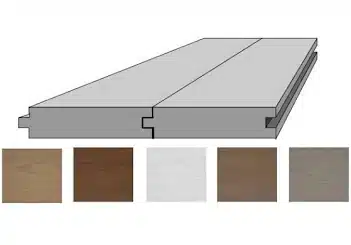
An honest comparison has to give credit where it is due. TimberTech AZEK offers far more design choice, including realistic wood-grain textures and many color families. If appearance variety drives your decision, AZEK has the broader catalog. Its published product warranties are also long, with a limited lifetime warranty and a 50-year fade and stain warranty on the boards.
AZEK also makes sense for homeowners who do not need a dry space at all. If you are building a ground-level deck and the area below does not matter, a gapped system avoids paying for sealing hardware you will not use.
Where SpaceMaker Has the Edge for Watertight Performance

When the goal is a dry space, SpaceMaker’s approach has a few practical advantages.
- One system, fewer parts. The seal, the ceiling surface, and the deck board are a single product. There is no separate trough, bracket set, or panel layer to buy, hang, and maintain.
- Water stays out of the framing. Because water is shed at the surface, joists are exposed to less repeated wetting and drying. The manufacturer says this helps the substructure last longer.
- Cleaner ledger details. A solid board is easier to flash and caulk at the house connection than a hollow profile, which is where trade professionals often see trouble.
- Less to clean. Under-deck drainage layers can collect leaves, pollen, and debris and typically benefit from periodic cleaning. A sealed surface moves that maintenance to the top of the deck, where it is easy to reach.
- Finished underside. Ceiling fans, lights, and speakers can go below the deck without a separate ceiling build.
The tradeoffs are real too. SpaceMaker comes in a narrower color selection, and the installation method asks for more care than a standard gapped deck, including correct pitch and proper flashing. Manufacturer coverage also depends on installation by a certified installer, so who builds the deck matters.
So Which One Wins?

It depends on what you are optimizing for.
If your priority is watertight performance, meaning a dry patio, storage space, or living area below an elevated deck with the fewest moving parts, a sealed-board system like SpaceMaker is built for exactly that job.
If your priority is appearance variety and long published board warranties, and you either do not need a dry space or are comfortable adding a separate drainage layer, TimberTech AZEK is a strong choice.
The best way to decide is to compare the products in your hands, on your own porch, in daylight.
Questions to Ask Before You Choose
- Who will install the deck, and are they trained on the system you pick?
- What does the written warranty require for installation, flashing, and sealants?
- How will water leave the deck: to the ground, or to a gutter and downspout?
- What upkeep does the underside need after the first few seasons?
- Is the full cost, including drainage or sealing components, itemized in the quote?
Order a Free SpaceMaker Sample and Judge It Yourself
Spec sheets can only tell you so much. Feeling the board is a different experience.
Order your free SpaceMaker deck sample and get a real piece of the board shipped to you at no cost and with no obligation. Check the solid core, the cap coat finish, and the Super Seal gasket up close, then compare it side by side with any other sample on your list. When you can see the difference, the decision gets a lot easier.
TimberTech and AZEK are trademarks of their respective owners. Admiral SpaceMaker is not affiliated with them. Information about competing products comes from publicly available manufacturer and retailer descriptions and may change, so please verify current specifications and warranty terms directly with each manufacturer.
Sources: Admiral SpaceMaker, SpaceMaker FAQ, Pro Remodeler, Lowe’s TimberTech AZEK product listing, TimberTech DrySpace product summary