
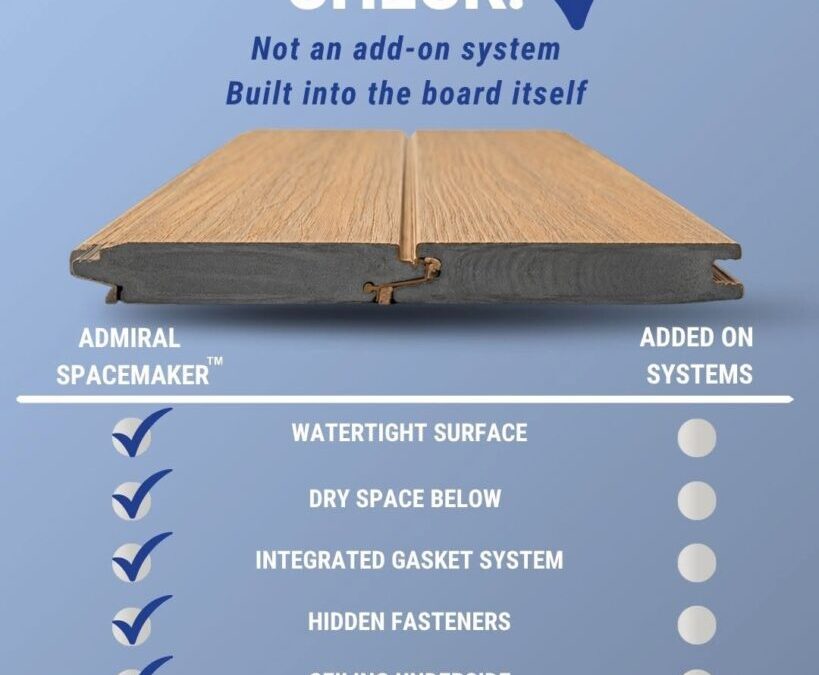
Watertight decking seals the joints between boards so rain runs off the surface instead of dropping through to the framing and ground below. Admiral SpaceMaker does this with a vulcanized silicone Super Seal gasket in its solid PVC, tongue-and-groove boards. The system needs a pitched frame and careful flashing, it does not create a ceiling, and it generally costs more than standard composite decking.
Watertight decking is a newer idea than most people expect, and it raises reasonable questions. How does a deck keep water out when it is made of boards? Is it different from an under-deck drainage system? Does it cost more, and is it worth it? The answers below are based on Admiral SpaceMaker’s published product information and installation guidance, plus trade coverage. Details can change, so confirm current specifications and warranty terms with the manufacturer before you order.
Admiral SpaceMaker at a Glance
| Feature | Detail |
| Board | 1 inch thick, tongue and groove |
| Lengths | 16, 20, and 24 feet |
| Material | Solid PVC with no fillers, ASA cap |
| Seal | Super Seal vulcanized silicone gasket, rated by the manufacturer as resilient from -100°F to 400°F |
| Fasteners | Standard 2-inch deck screws, driven at an angle through the tongue |
| Ledger flashing | Aluminum deck ledger flashing |
| Edge option | Edge piece with drainage slots 4 feet on center, plus an optional Waterbox concealed gutter |
Specifications come from 2017 trade coverage in Pro Remodeler and manufacturer claims. Confirm current details with Admiral SpaceMaker.

The Basics
1. What is watertight decking?
Watertight decking is a deck board system designed to seal the joints between boards so rain runs off the surface instead of falling through. A standard deck has gaps, so water reaches the framing and the ground below. A watertight system sheds water at the surface, which helps keep the area underneath drier and more useful.
2. How does Admiral SpaceMaker keep water out?
Admiral SpaceMaker boards are tongue-and-groove, and a silicone gasket called the Super Seal wraps the tongue. As each board is pushed into the next, the gasket compresses and forms a seal, and water moves across the surface toward the deck edge. The manufacturer describes the gasket as vulcanized silicone that stays resilient from -100°F to 400°F.
3. Is it really waterproof?
It is designed to shed water at the joints, and many homeowners use it to create a drier space below. Like any deck, its performance depends on installation. Correct slope, tight board seating, and careful flashing and sealing at the house connection all matter, so ask your installer how they handle each one.
4. How is it different from an under-deck drainage system?
An under-deck drainage system lets water fall through the gaps, catches it below with troughs or panels, and routes it to a gutter. Admiral SpaceMaker stops the water at the surface, so there is no separate layer underneath. Some homeowners prefer fewer parts to maintain. Others want the finished panel look overhead that a drainage system can provide.
5. Does Admiral SpaceMaker create a ceiling?
No. The boards are the deck surface above, and the joists, trusses, and beams remain exposed underneath. A finished look overhead would be a separate addition. Many people like the open framing because it is easy to inspect and to hang lights or fans from.
Materials and Appearance
6. What is it made of?
Admiral SpaceMaker boards are solid PVC with no fillers and a protective ASA cap. A solid board is easier to cut, caulk, and flash than a hollow profile, which matters at the ledger and at board ends.
7. What colors does it come in?
The palette is smaller than what large mainstream composite brands offer. Trade coverage in 2017 listed two variegated colors, Tropical Brown and Nantucket Gray. Ask for the current colors and a sample so you can compare them with your siding, trim, and railing in real light.
8. Does it get hot in direct sun?
All decking warms up in direct sun, and color affects how much. The best test is to leave a sample outside on a sunny day and put your hand on it.
Installation
9. Does it need a sloped frame?
Yes. A watertight deck has to drain, so the frame is built with a slight pitch away from the house. One eighth of an inch of drop per foot of run is a common baseline, and some builders go to a quarter inch for extra margin. Confirm the required pitch in Admiral SpaceMaker’s installation guide.
10. How is it installed?
Boards are pushed together to compress the seal, then fastened with standard 2-inch deck screws driven at an angle through the tongue, so the surface stays clean. Installers set boards in a bead of exterior-rated sealant, and trade coverage names OSI Quad Max caulk and aluminum ledger flashing. Water can drop off the edge or be directed into a gutter.
11. Can I put it on my existing deck frame?
Sometimes. The frame must be sound, properly flashed, and able to be pitched correctly, and a qualified installer should inspect it first. If the framing is damaged, repair it before installing a new surface.
Warranty, Cost, and Care
12. What warranties does it come with?
Admiral SpaceMaker has listed structural, fade and stain, water-tight, and labor warranties. The labor warranty requires installation by an installer trained and certified by Admiral and is not transferable. Request the current warranty documents for exact lengths, conditions, and exclusions.
13. Does it cost more than standard composite decking?
Generally yes, because the board does two jobs, as a walking surface and as a water barrier. Trade coverage in 2017 put it at about twice the cost of other composite decking, and a deck builder in that article noted the total installed cost can come out lower once separate under-deck drainage is counted. Ask for an itemized quote that separates boards, edge and drainage components, flashing, labor, and permits.
14. How do I take care of it?
Keep the surface, the edges, and any gutter clear of leaves and debris so water can leave freely. Clean the surface following the manufacturer’s care instructions, and inspect the ledger area and sealant joints periodically.
15. Does keeping water off the framing really matter?
It can. Pressure-treated lumber swells when it absorbs water and shrinks as it dries, and repeated cycles can loosen fasteners. Standing moisture and debris in joist bays can also speed up rot. Shedding water at the surface helps keep joists drier, and proper flashing at the joists and ledger still plays an important role in protecting the frame.
Questions to Ask Before You Buy
- Who will install it, and are they trained and certified on this system?
- How will water leave the deck: to the ground, or into a gutter and downspout?
- What does the written warranty require for installation?
- Is the pitch built into the framing plan?
- Are flashing and sealants itemized in the quote?

Hold the Board in Your Hands
A written answer can only go so far. The easiest way to understand watertight decking is to see the board and the seal in person.
Order your free Admiral SpaceMaker deck sample and receive a real piece of the board at no cost and with no obligation. Look closely at the solid core, the cap finish, and the Super Seal gasket, then compare it with any other sample you are considering.Sources:Pro Remodeler, Admiral SpaceMaker Outdoor Flooring, Admiral SpaceMaker FAQ, Admiral SpaceMaker warranty page, Admiral SpaceMaker installation guide